

By /Xinhua Daily / Updated: 19:11,
Source: Hainan Provincial Department of Agriculture and Rural Affairs
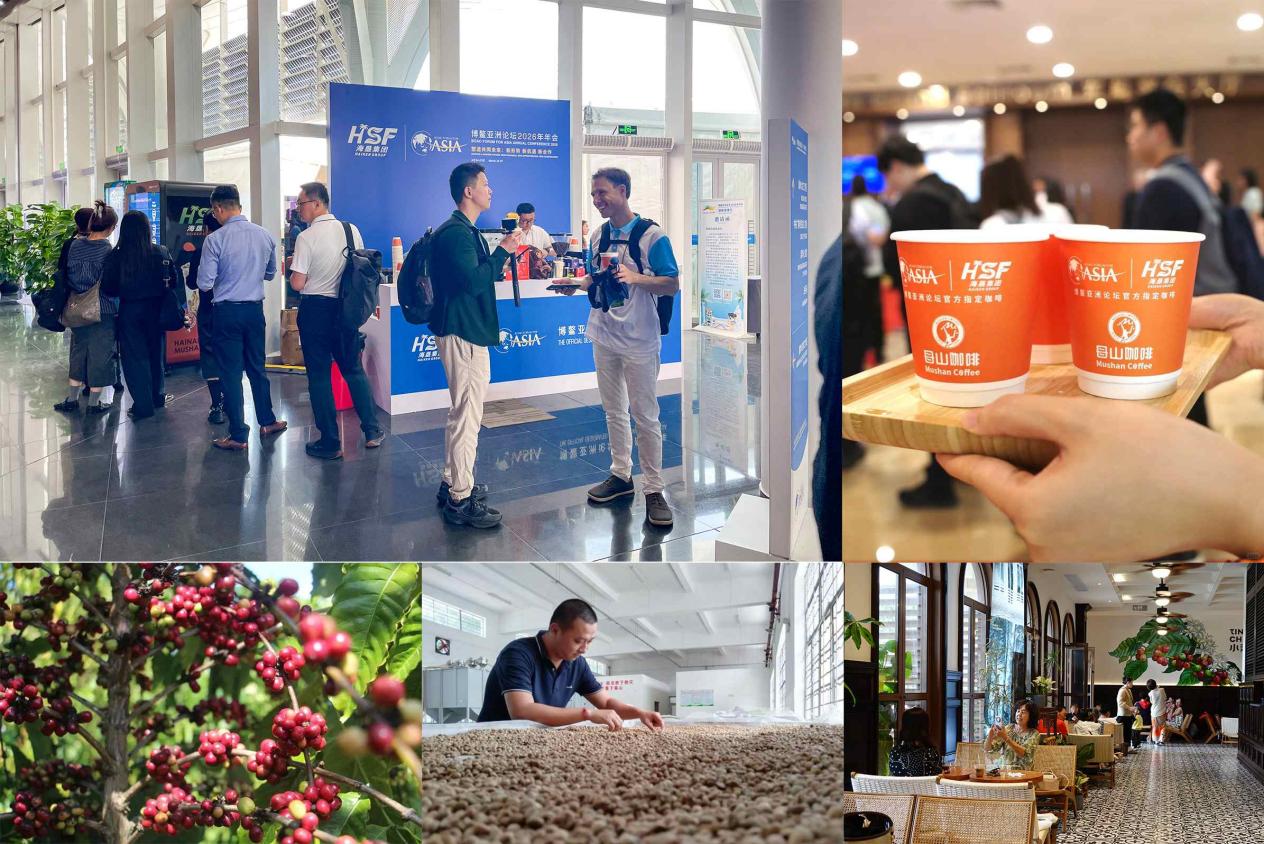
Every late March, at the Boao Forum for Asia aAnnual cConference, long lines form in front of the self-service smart coffee vending machines of Mushan Coffee at the Boao Forum for Asia Annual Conference. On the first day of this year's conference, over 2,000 cupsdrinks were served.the three machines served over 2,000 cups.
Mushan Coffee, produced in Qiongzhong, Hainan, has made its appearancebeen featured at the Boao Forum for Asia aAnnual cConferences for five consecutive years, winningcaptivating over the palates of global guests, journalists, and staff with its rich sweetness and fruity aroma.
"The first time I served at the annual conference, a guest heard that Hainan coffee beans are of the Robusta variety and worried Hainan's Robusta beansthat it would tastebe too bitter and astringent," recalled barista Chen Fang. "A. But after tasting it, they were surprised to find a sweet note and fruity fragrance. Now, instead of asking 'Why Robusta?' they ask, 'How do you get such great flavor?'" said Chen Fang, a barista.
Robusta beans have lLong dismissedbeen labeled as "bitter" and "cheap," often usedfit only as raw material for instant coffee, Robusta has undergone a remarkable renaissance in China. But over the decades in China, they have undergone a remarkable transformation.
Located in the low-latitude tropical zone, Hainan Island is one of China's earliest coffee-growing regions, with idealclimatic conditions well-suited for Robusta cultivation. Starting inince1957, researchers at the Spice and Beverage Research Institute, Chinese Academy of Tropical Agriculture Science,have systematically improved the cropadvanced improvements across five dimensions: variety selection, cultivation techniques, quality enhancement, processing methods, and standardization systems. Providing end-to-endThey have provided technical guidance to farmers throughout the entire process—from seedling breeding and efficient cultivation to pest and disease control—they have transformedenabling standardized planting management. These efforts have helped elevate Hainan Robusta from an "industrial commoditybean" into a premiumproduct that is high-quality, high-yield, resilient crop with superior flavor profilesdisease-resistant, and rich in flavor.
According to the Hainan Provincial Department of Agriculture and Rural Affairs, by 2025, the province had developed 26,000 mu (about 4,300 acres) of coffee plantations, with an annual processing capacity of 40,000 metric tons. Through comprehensiveFrom the selection of superior varieties and intercropping with other crops to the primary processing of fresh coffee cherries, Hainan has established whole-industry-chain standards covering seeds, seedlings, cultivation, storage, processing, roasting, and brewing, the province has achieved end-to-end standardization——promoting a "from seed to cup" standardization of the coffee industry..
InAt the processing stage, innovative coffee producers in Hainan have adopted refined techniques such as honey processing and anaerobic fermentation, coaxingallowing Robusta to express tropical fruit notes likeof pineapple and mango from the Robusta bean.
"Coffee has great potential for extension and fusion. We combine tropical fruits, vegetables, and other ingredients with coffee to develop products with distinctive Hainan characteristics," said Li Changjian, general manager of Hainan State Farms Mushan Coffee Co., Ltd.
These specialty products are now availablewithin easy reach at caféscoffee shops across Hainan. Since opening its first directly operated café in Haikou in 2021, Mushan Coffee has expanded to 36 locationsoffline stores. InnovativeNew offerings such as Green Orange Americano, Island Milk Coffee, and Pandan Coconut Latte continuously cater to the ever-evolving tastes of young consumers.
Beyond the café culture embedded in urban life, "coffee + tourism" has also emerged as a thriving industry in some of Hainan's cities and counties. In the town of Xinglong in Wanning, the Longyuan Coffee Estate—a coffee-themed farm covering about 200 mu (approximatelyroughly 33 acres)—integrates plantation areas, a processing facility, a coffee house, an experience center, and a restaurant. Visitors can try their hand at every step from planting and harvesting to processing and grinding, and also sample specialty dishes such as coffee fruit stewed chicken and coffee peel tea. Currently, more than five large-scale coffee estates are officially open to visitors in Wanning.
InAt the Taling Industrial Park in Ding'an, Hainan, the internationally renowned Mixue Ice Cream & TeaMixue Bingcheng is exploring yet another dimension of the coffee industry. The company's 288-mu (about 47-acre) facility blends coffee beans from different countries according to proprietary recipes, with an annual production capacity of 22,000 metric tons.
Under the Hainan Free Trade Port policies, green coffee beans are exempt from import tariffs, value-added tax, and consumption tax. With an 8- percent tariff saving, combined with other cost optimizations at the import stage and the "dual 15- percent" corporate and individual income tax incentives, overall costs can be reduced by 30 to 40 percent.
Lower costs have led to more active trade. In 2025, Hainan imported 9,110 metric tons of coffee beans and products, a 5.6-fold increase year-on-year, with a total value of 480 million yuan (approximately 66 million U.S. dollarsUS$66 million), up 8.3 times. Exports reached 169.5 metric tons valued at 12.64 million yuan, representing growth of 51.9 percent and 49.6 percent respectively. Exported products include dark-roast coffee beans and coffee powder for espresso and American-style coffee, as well as distinctive Hainan specialties like coconut milk coffee, sold to 17 countries and regions including Malaysia, Indonesia, the United States, and Australia.
In the past, Hainan was merely a coffee consumption market. Today, the landscape has changed significantly, with an increasing number of coffee industry chain enterprises gathering in Hainan. Green coffee beans from Brazil, Indonesia, Vietnam, Colombia, and other originplaces now converge in Hainan, where they are locally processed and customized into specific flavor profiles before being sold to the Chinese mainland or exported overseas. The next cup of coffee you enjoy may well carry the aromatic story of Hainan—a taste that has traveled the globe.
Email:nytxxzx@163.com
Copyright @ 2021 Department of Agriculture and Rural Affairs of Hainan Province
